Showing posts with label science articles. Show all posts
February 08, 2018

Intel's quirky new chips are made for quantum computing and machine learning

by , in
 Intel has unveiled its latest quantum computing test chip, named "Tangle Lake," at CES this week(Credit: Walden Kirsch/Intel Corporation)
It turns out that combining a CPU and a GPU into one package isn't the most unconventional processor Intel had up its sleeve for CES 2018. Now the company has revealed a new quantum computer test chip containing 49 quantum bits (qubits), as well as a "neuromorphic" chip based on the function of the human brain.
Quantum computers could be the next big frontier in computing, with companies like Intel, IBM and Google racing to develop the technology. They have the potential to be far more powerful than traditional computers: where a normal bit of information is stored as either a 1 or a 0, a qubit takes advantage of the quirks of quantum physics to store data as 1, 0 or both at the same time. The exponential growth with each added qubit means that a system with 5 qubits is about the equivalent of 32 regular bits.
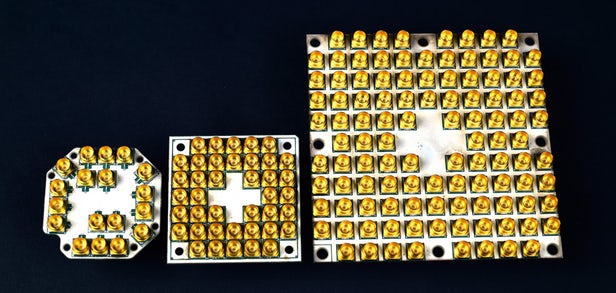
 The progression of Intel's quantum computing chips, from left: 7 qubits, 17 qubits, and the latest with 49 qubits(Credit: Walden Kirsch/Intel Corporation)
Intel's newest quantum computer test chip, named "Tangle Lake," boasts 49 qubits, which could theoretically make for a computer system that rivals our current best supercomputers – if it was ready for commercial use. That, it seems, is still a long way off, but milestones like these show just how fast the technology is advancing – a 17 qubit device was a big deal when IBM revealed it back in May last year.
IBM also still holds the record of most powerful quantum chip, with a 50 qubit model unveiled in November.
"In the quest to deliver a commercially viable quantum computing system, it's anyone's game," says Mike Mayberry, managing director of Intel Labs. "We expect it will be five to seven years before the industry gets to tackling engineering-scale problems, and it will likely require 1 million or more qubits to achieve commercial relevance."
Intel's Neuromorphic chip, codenamed Loihi, is modeled on the way the human brain processes and stores information(Credit: Intel Corporation)
The other Intel reveal was a Neuromorphic chip codenamed Loihi. Similar to a neural network, this system is modeled on the way the human brain processes and stores information. Instead of processing data in one component before sending it to another for storage, the chip performs both functions in the same spot. As the chip learns, it rewires its own connections to speed up the process and make for a more efficient system.
Loihi is due to be tested in research institutions in the first half of 2018, where it can tackle complex data sets. Intel engineers describe how Loihi works in the video below.
Source: Intel, NewAtlas
February 07, 2018

Rolls-Royce claims world's most powerful aerospace gearbox record (70,000 horse power)

by , in
Rolls-Royce is inching closer to having a production-ready UltraFan engine(Credit: Rolls-Royce Aerospace)

A successful test has seen Rolls-Royce claim the world record for the world's most powerful aerospace gearbox with its Power Gearbox. The unit is capable of handling the power from around 400 regular family cars running at full throttle and will form a key part of Rolls-Royce's next-generation UltraFan engine, allowing it to operate efficiently through the full range of thrusts.
The Power Gearbox was first tested last year, but power wasn't the focus. Engineers used the Rolls-Royce Attitude Rig to simulate climbing, descending and banking, and find out how each maneuver affected the oil system.
The latest tests were more rigorous. Paul Stein, CTO at Rolls-Royce, used a speech at the International Society for Air Breathing Engines (ISABE) to announce 70,000 hp (52,199 kW) had successfully been run through the 'box at the company's German facility. It will eventually channel 100,000 hp (74,570 kW), at which point Rolls-Royce says each pair of teeth on the gearbox will be transmitting more power than the entire F1 grid.
Why? Well, fitting bigger fans to aircraft engines delivers more power, but it also necessitates the fitment of bigger turbines – and there comes a point where turbines would need to be prohibitively large for any meaningful power gain. UltraFan is designed to avoid this problem, using the (planetary) Power Gearbox to keep the turbine and fans spinning at the ideal speed throughout a flight for more power and better efficiency.
"Setting this record is a great achievement for the team and I'm proud we've managed to get there so quickly," says Paul Stein, CTO at Rolls-Royce. "Our Power Gearbox technology is central to the success of the next generation of Rolls-Royce jet engines and I'm pleased to see us pushing back engineering boundaries with this work."
When it arrives in 2025, the UltraFan engine is expected to be around 25 percent more efficient than current-generation Rolls-Royce Trent engines.
Source: Rolls-Royce Aerospace,NewAtlas


February 05, 2018

Construction begins on first manned Orion spacecraft

by , in

At the NASA Michoud Assembly Facility in Louisiana, Lockheed Martin technicians have started building the first manned Orion(Credit: NASA)

NASA's first of a new generation of manned deep space exploration craft has begun to take shape at the space agency's Michoud Assembly Facility near New Orleans. This week, Lockheed Martin technicians and engineers welded together the first two components of the Orion crew capsule for Exploration Mission-2 (EM-2), which will carry astronauts beyond low Earth orbit for the first time in almost 50 years.
So far, only one operational Orion capsule reached space when the unmanned Exploration Flight Test-1 (EFT-1) lifted off atop a Delta IV Heavy booster on December 5, 2014. A second, more advanced Orion is currently being prepared for Exploration Mission-1. It's scheduled to fly in 2019 using the Space Launch System (SLS) rocket, but again, without a crew.
Though the EM-2 Orion will be a major step in the American program to establish a Deep Space Gateway station, return to the Moon, and eventually make a manned landing on Mars, it isn't much to look at at the moment. The first construction step involved welding the command capsule's forward bulkhead to the tunnel section, to form the top of the spacecraft. In all, seven large machined aluminum alloy pieces will form the pressure vessel, which is the main hull of the craft.
"Orion has tremendous momentum. We're finishing assembly of the EM-1 Orion spacecraft in Florida, and simultaneously starting production on the first one that will carry crew," says Mike Hawes, Lockheed Martin vice president and program manager for Orion. "This is not only the most advanced spacecraft ever built, its production will be more efficient than any previous capsule. For example, look at the progress we've made on the EM-2 pressure vessel compared to the first one we built. The latest version is 30 percent lighter and has 80 percent fewer parts. That equates to a substantially more cost-effective and capable spacecraft."
Early  artist's rendering of the Orion crew capsule in lunar orbit. Work is now underway on the real thing.(Credit: Lockheed Martin Corp. )
Lockheed says that construction will continue through September as the three cone panels, large barrel, and aft bulkhead are added on. It will then be shipped to the Kennedy Space Center for final assembly and testing.
"The EM-1 and EM-2 crew modules are very similar in design, but we've made a lot of improvements since we built EM-1, including processes, scheduling, and supply chain, all contributing to a lower cost and faster manufacturing," says Paul Anderson, director of Orion EM-2 production at Lockheed Martin. "Each of these spacecraft are important, but we realize that the EM-2 capsule is special as it's the first one to carry astronauts back out to the Moon, something we haven't done in a long time. It's something we think about every day."